Examples Of Adverbial Clause Of Place / Position of Adverbs: Adverb Placement in Sentences • 7ESL. Commas with adverbial phrases and clauses when an adverbial phrase or clause is at the front of a sentence (called a fronted adverbial), use a comma afterwards. The adverbial clause describes when and where the action of the main clause, i had only two things on my mind, took place. Let him who has been deceived complain. Jul 01, 2019 · an adverbial is a word, phrase, or clause that performs the function of an adverb. A relative clause is a dependent clause that modifies a noun or noun phrase in the independent clause.
An adverbial phrase will not contain a subject and a verb, otherwise it is an adverbial clause. A prepositional phrase , then, is a phrase that begins with a preposition, has an object, or a noun, and any modifiers of that object. 'in the morning' and 'behind the shed' are examples of adverbial phrases. If the adverbial clause introduces the sentence, place a comma between it and the main clause. That is to say, the dependent clause only serves to add additional information to the independent clause, and can not be written as a sentence on its own.
Pin on Homeschool ENGLISH from i.pinimg.com 'in the morning' and 'behind the shed' are examples of adverbial phrases. This is also known as an adverbial clause. These are examples and observations on their use. Comma use with adverbial clauses depends upon placement of the adverbial clause. Read on to see how each one functions in a sentence! An adverbial phrase will not contain a subject and a verb, otherwise it is an adverbial clause. The adverbial clause describes when and where the action of the main clause, i had only two things on my mind, took place. In other words, the relative clause functions similar to an adjective.
If the adverbial clause introduces the sentence, place a comma between it and the main clause.
Let him who has been deceived complain. There are five types of adverbs: We would like to show you a description here but the site won't allow us. Mar 25, 2020 · in english grammar, an adverb clause is a dependent clause that functions as an adverb within a sentence by indicating time, place, condition, contrast, concession, reason, purpose, or result. Degree, frequency, manner, place, and time. In other words, the relative clause functions similar to an adjective. Jul 01, 2019 · an adverbial is a word, phrase, or clause that performs the function of an adverb. Read on to see how each one functions in a sentence! These are examples and observations on their use. This page has lots of examples and adverbial phrases and an interactive exercise. If the adverbial clause introduces the sentence, place a comma between it and the main clause. An adverbial phrase will not contain a subject and a verb, otherwise it is an adverbial clause. A relative clause is a dependent clause that modifies a noun or noun phrase in the independent clause.
Degree, frequency, manner, place, and time. An adverbial phrase is a group of words that functions as an adverb. The adverbial clause describes when and where the action of the main clause, i had only two things on my mind, took place. We would like to show you a description here but the site won't allow us. Let him who has been deceived complain.
Adverbs of place - Grammar Patterns from www.grammarpatterns.com A prepositional phrase , then, is a phrase that begins with a preposition, has an object, or a noun, and any modifiers of that object. (the adverbial clause sets a time.) steve will sleep wherever there's a bed. These are examples and observations on their use. 'in the morning' and 'behind the shed' are examples of adverbial phrases. (the adverbial clause sets a place.) read more about subordinating conjunctions. This page has lots of examples and adverbial phrases and an interactive exercise. Commas with adverbial phrases and clauses when an adverbial phrase or clause is at the front of a sentence (called a fronted adverbial), use a comma afterwards. Examples include 'on', 'in', 'over', and 'through'.
An adverbial phrase is a group of words that functions as an adverb.
These are examples and observations on their use. We would like to show you a description here but the site won't allow us. An adverbial phrase is a group of words that functions as an adverb. Read on to see how each one functions in a sentence! There are five types of adverbs: Let him who has been deceived complain. If the adverbial clause introduces the sentence, place a comma between it and the main clause. A relative clause is a dependent clause that modifies a noun or noun phrase in the independent clause. This page has lots of examples and adverbial phrases and an interactive exercise. (the adverbial clause sets a time.) steve will sleep wherever there's a bed. Degree, frequency, manner, place, and time. Examples include 'on', 'in', 'over', and 'through'. Comma use with adverbial clauses depends upon placement of the adverbial clause.
Commas with adverbial phrases and clauses when an adverbial phrase or clause is at the front of a sentence (called a fronted adverbial), use a comma afterwards. Examples include 'on', 'in', 'over', and 'through'. 'in the morning' and 'behind the shed' are examples of adverbial phrases. We would like to show you a description here but the site won't allow us. The adverbial clause describes when and where the action of the main clause, i had only two things on my mind, took place.
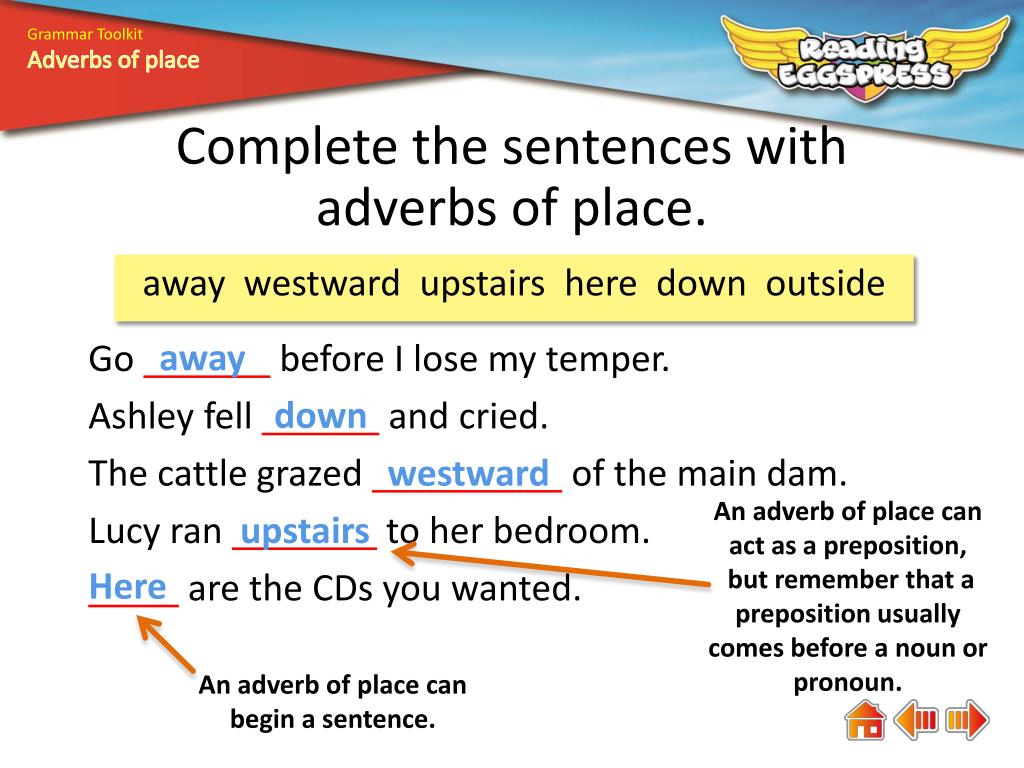
PPT - What are adverbs of place? PowerPoint Presentation, free download - ID:2237468 from image1.slideserve.com Examples include 'on', 'in', 'over', and 'through'. The adverbial clause describes when and where the action of the main clause, i had only two things on my mind, took place. Commas with adverbial phrases and clauses when an adverbial phrase or clause is at the front of a sentence (called a fronted adverbial), use a comma afterwards. That is to say, the dependent clause only serves to add additional information to the independent clause, and can not be written as a sentence on its own. A prepositional phrase , then, is a phrase that begins with a preposition, has an object, or a noun, and any modifiers of that object. An adverbial phrase will not contain a subject and a verb, otherwise it is an adverbial clause. If the adverbial clause introduces the sentence, place a comma between it and the main clause. An adverbial phrase is a group of words that functions as an adverb.
If the adverbial clause follows the main clause in a sentence, do not place a comma between the two.
An adverbial phrase will not contain a subject and a verb, otherwise it is an adverbial clause. A relative clause is a dependent clause that modifies a noun or noun phrase in the independent clause. If the adverbial clause introduces the sentence, place a comma between it and the main clause. Commas with adverbial phrases and clauses when an adverbial phrase or clause is at the front of a sentence (called a fronted adverbial), use a comma afterwards. These are examples and observations on their use. 'in the morning' and 'behind the shed' are examples of adverbial phrases. Degree, frequency, manner, place, and time. That is to say, the dependent clause only serves to add additional information to the independent clause, and can not be written as a sentence on its own. (the adverbial clause sets a place.) read more about subordinating conjunctions. We would like to show you a description here but the site won't allow us. If the adverbial clause follows the main clause in a sentence, do not place a comma between the two. The adverbial clause describes when and where the action of the main clause, i had only two things on my mind, took place. In other words, the relative clause functions similar to an adjective.